How Poker Pros Think: An excerpt from the new book by Dara O’Kearney and Barry Carter
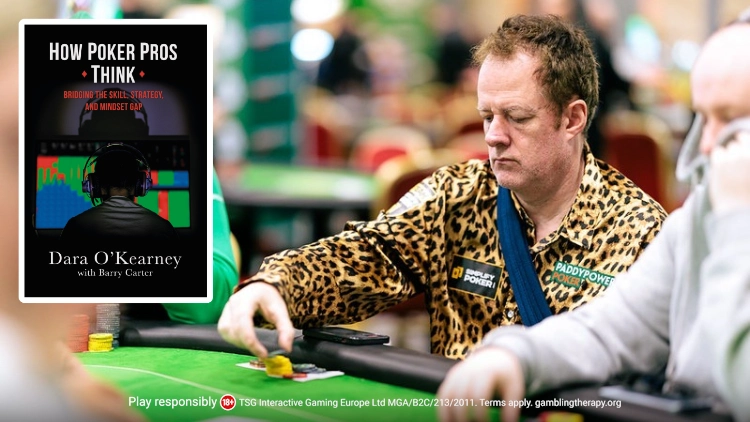
PokerStars Blog presents an exclusive excerpt from the new book How Poker Pros Think, by Dara O’Kearney and Barry Carter. This chapter is all about “edge passing”.
What if you already knew how to play like a professional poker player?
The gap between professionals and amateurs often isn’t knowledge. It’s execution. Amateurs know what they should be doing. Professionals actually do it.
In How Poker Pros Think, Dara O’Kearney breaks down the skill, strategy and mindset gap between professional and recreational poker players. This isn’t a book about turning pro. It’s about understanding how pros think, so you can close that gap yourself.
It’s a guide to finally doing the things you know you should be doing at the tables, but have held back on through fear of looking stupid.
Below you’ll find an excerpt from How Poker Pros Think. Chapter 13 – Edge passing.
You can purchase How Poker Pros Think here.
AN INTRODUCTION TO EDGE PASSING
Something that professionals do, which amateurs rarely do, is edge passing. This is where they pass on a profitable opportunity because they believe better opportunities are on the horizon. The main reason why professionals edge pass is because they have an edge in the first place.
The typical example that often hypothetically gets talked about is if you have QQ at a soft table on level one the WSOP Main Event, your opponent goes all in and you are very confident they have AK.
You have a small edge here. QQ is the small favourite in this hand, but do you really want to take a high variance flip right now? If you have a very big edge at the table, it would be correct to pass here and enjoy a much bigger edge in future hands.
I’ve argued with players about edge passing before, and the push back I’ve received is that you should take every profitable spot. The logic is that if you win that profitable spot, it just gives you more leverage to push your edge.
To those players, I give them this hypothetical scenario.
Imagine someone offers to flip a coin with you, where if you win, you get $2,000, and if you lose, you get $1,000. However, if you lose, you are out of the game.
This is an incredibly profitable offer, and you should take it.
However, what if you know after your decision, someone else will offer you the same flip, except you get $10,000 if you win?
There is no way you should take the first flip. Losing would mean you miss out on the opportunity to flip for five times the top prize.
Edge passing is not an exact science, or at least it’s not something you’d ever be able to quantify in the moment at the tables. What it is in a nutshell is identifying a profitable spot and trying to predict if there will be better profitable spots in the future.
EXAMPLE: A NIGHTMARE TABLE
I was once playing in a tournament at Dusk Till Dawn where everybody at my table was a crusher. It was a nightmare table where you wouldn’t want to pass any profitable spot because you wouldn’t know if another one was coming along. However, a satellite was concluding on the other side of the card room, with the winners coming directly into our event. As a result, everybody at our table understood this and was playing slow and tight. This was a perfect situation to pass small edges because we all knew that much softer tables were on the horizon.
A similar example everybody has seen recently is the Pro/AM Invitational events that Triton hosts. On day one of these tournaments, the professionals all play against each other, and the amateurs all play against each other, with the two player pools meeting on day two. The professionals have every reason to play tight and pass small edges at the table because making it to day two, which is going to be infinitely more profitable, is the goal. You may have experienced something similar yourself when the bounty period is about to kick in in a Mystery Bounty tournament. There is no need to do anything wild when you have a decent stack moments before the bounties kick in, because you want to put that stack to good use when the game becomes more profitable.
Edge passing is all about how many good future prospects you have available to you after this decision.
If you are playing in a fast-structured tournament like a hyper turbo, it’s probably not a good idea to edge pass (unless ICM is a factor and stalling is beneficial). This is because you could easily blind out before you get dealt another profitable spot.
If you’re in a slow-structured tournament with a healthy stack, this is a good opportunity to edge pass. As the saying goes, you can wait for a better spot.
The opportunity to play other games is another reason to consider the merits of edge passing. If you are playing online, you should have an abundance of opportunities in terms of games you can play. There is less reason to edge pass, therefore, because you can load up another tournament if things go poorly. In fact, to go back to my boxes analogy from the volume chapter, one of your tables might not be worth much money to you. You may be short-stacked in your lowest-stakes tournament, for example, and there might be a good tournament that’s overlaying available in the lobby. You should not pass any edge in this spot. In fact, it might be correct to take a slightly negative EV action because if it goes well, you double up, and if it goes poorly, you get to register another, probably more profitable, tournament.
WHEN AND WHY
Likewise, if re-entry is an option and you have the bankroll to do it, you should not be as concerned about edge passing. In fact, if the re-entry period is close to closing, this might be another spot where it’s correct to take a slightly minus-EV move, and if it goes poorly, you have another shot at re-entering.
If you are deep in a tournament, however, edge passing makes more sense. Your equity is much higher, and you perhaps are already in the money, so you don’t want to take a negative EV spot. When ICM is significant, this is perhaps the best time to edge pass, particularly if folding might mean that two other players collide and give you a pay jump.
In contrast, if you are playing in a live tournament freezeout with no other side events available, this is a spot where you should definitely consider edge passing. The downside of busting early in this situation is not only that you lose your buy-in, but also that you’ll have nothing to do afterwards. So if you have a slightly profitable spot, it may be worth passing to stay in the game so you can hunt for better opportunities.
How your opponents play is one of the biggest factors in whether you should edge pass or not. The more weak players that are at your table, the more you should edge pass. There is no need to take a high-variance flip against a calling station when they are almost certainly going to pay off a stronger hand later. Once again, when ICM is a factor, this is a reason to edge pass, as these weaker players are more likely to collide with each other and give you a pay jump.
The more good players you have at your table, the less you should edge pass. Good opportunities don’t come up very often against superior players, so if you believe you have a small edge with your hands, you should take it.
The one caveat to that is when you are at a good soft table with one or two other good players. Quite simply, you should be avoiding the good players as much as possible and concentrating on the weaker players. There is no reason to go to war with one of the few good regs at the table when you are profitable against all the other players. For this reason, you should avoid flips, keep the pot small, and generally stay out of the way of the good players.
WHAT DOES EDGE PASSING LOOK LIKE?
We have looked at the why of edge passing, but what does it actually look like?
For the most part, it’s folding. It’s simply not playing a hand that you otherwise would have played because it’s not as strong as you would like it to be to risk going broke. For example, let’s say you are at a soft table, and the effective stacks are 40bbs. You open the BTN, and the SB shoves for 40bbs. It folds back around to you.
In GTO world, this would be your calling range:
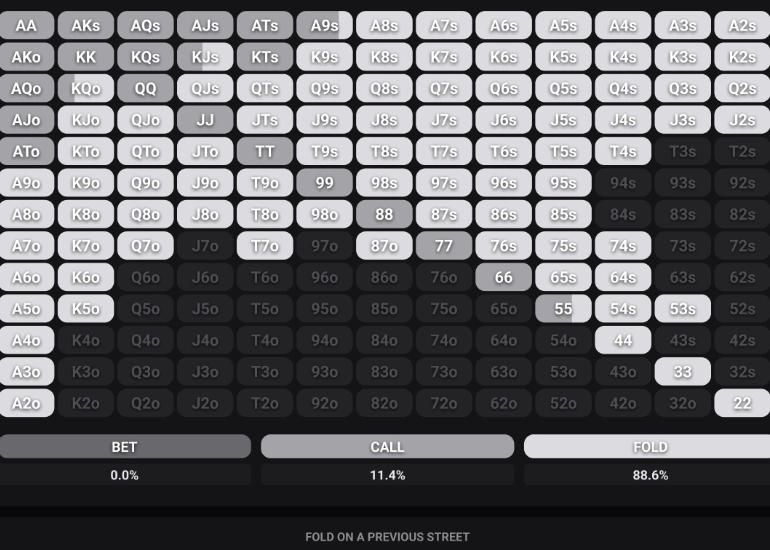
You are always calling with AA. That makes, on average 31.6bbs. In contrast, though, 55 makes a mere 0.01bbs on average. ATs makes 2.51bbs on average.
In GTO world, you should call with all of these hands, but you are never going to truly be in GTO world. If you are at a particularly soft table, you should definitely fold the 55, and you could also make a strong case for folding the ATs. You’d obviously never fold the QQ or the KK. It’s essentially just about shaving off the bottom of your range, the hands that are on the fringes.
High stakes online crusher Bencb has a useful heuristic for this. He suggests that if a hand makes 5% of what AA makes, you can consider passing it, but if it makes 10% of what AA makes or more, you should never pass it.
We’ve already shown you that AA makes 31.6bbs on average, and ATs makes just 2.51bbs, which is less than 10% of AA. That makes ATs a potential fold in a soft game. AJs, however, makes 4.74bbs, which is more than 10%, so it should never be folded.
DECIDING IN REAL TIME
As mentioned at the start, you will never truly be able to accurately estimate your edge and the profitability of future spots in real time at the tables. This is more something that you guesstimate with experience. You probably didn’t need me to point out the average bb/100 of the hands above to intuitively know that AJs is probably a call and ATs is probably a fold.
I have a more practical heuristic in these spots. If I am considering whether to pass a small edge, I think about what I would do with the hand just above and just below that hand. So if I am thinking of folding ATs I would ask myself, “What would I do with A9s?”. If the answer is that I would snap-fold A9s, that makes passing ATs much easier. Likewise, I would ask myself, “What would I do with AJs” – if the answer is snap call, then I have a tougher decision with ATs, but if I am unsure whether I would call with AJs, then, again, ATs becomes an easy fold.
Another form of edge passing is simply to keep the pot small. There are a number of benefits to this that professionals employ all the time. First of all, you mitigate your downside. In close spots and the times where you were wrong, you avoid going broke. The other advantage to keeping the pot small is when you have an edge yourself. Professional poker players keep pots small against amateur players because the more decision points they have in the hand, the more they can exert their own edge. If you bloat the size of the pot, you reduce the stack-to-pot ratio, which means that amateur players will make fewer mistakes. It’s hard to make a mistake with top pair when you only have a pot-sized bet behind.
One of the most useful training tools we’ve discovered at Simplify Poker Academy is watching the replays of online final tables with high-stakes crushers in them. One of the most notable things about these replays is how small most of the players keep the pots. Players like Stephen Chidwick and Adrian Mateos will rarely get into a shovefest battle with each other. They will usually keep the pot small, keep their variance low, and wait for more profitable spots against the weaker players.
One form of edge passing that even weak players intuitively know how to employ is stalling. When ICM is significant, in particular on bubbles and when there are pay jumps, reducing the number of hands that you play works to your benefit. Any time where playing too many hands could be costly is a reason to stall. The classic example is a satellite bubble where you have a seat almost locked up. There is no reason to play any more hands if you can avoid it.
There are other non-ICM times when stalling might make sense. If you are at a very tough table but you know your table is going to break next, or if there is going to be a table redraw, it makes perfect sense to play fewer hands to try and survive to the more profitable situation.
In contrast, good professional poker players know when they should be playing as fast as possible. I was at a very soft table with one other good professional poker player, Mike Leah, who discreetly told me that our table was going to break next. He told me this so that I would correctly pick up the pace. We had every reason to play as fast as possible so we could play as many hands as possible. This meant folding our hands quickly, and helping the dealer deal hands as quickly as possible.
CONCLUSION
It should go without saying that edge passing is only a consideration for players with an edge. After that, edge passing is all about making an on-the-fly estimation about how profitable your current situation is versus how profitable your future situations might be.
At tough tables and fast structures, you should avoid edge passing because the profitable opportunities won’t come along very often. At slow tables, and in particular at soft tables, you should avoid high-variance, slightly profitable spots because a wealth of opportunities should come your way if you are able to stay in the game.
You can purchase How Poker Pros Think here.
Back to Top
Latest Articles




View Other Blogs